
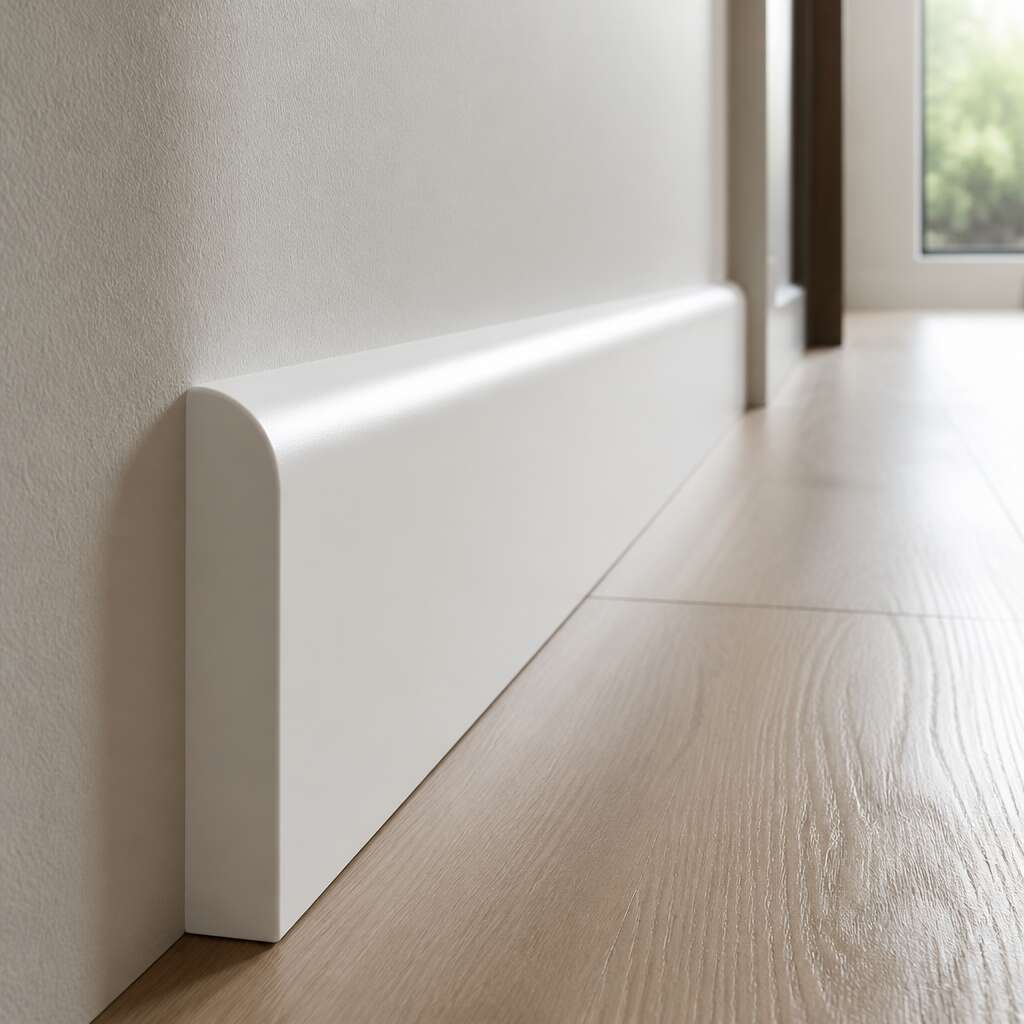
Understanding Bullnose Profiles for Modern Interiors
What Defines a Rounded Skirting Edge
Walk into any modern show home and you will notice the same detail: corners that curve instead of cut. The bullnose profile, defined by its continuous radius, removes the sharp transition between wall and floor. This rounded edge softens the sightline, making rooms feel less rigid. In my experience, it is the profile clients rarely regret.
Unlike ogee or chamfered alternatives, the bullnose avoids ornamentation. Its appeal rests on a simple geometric principle. The arc catches light evenly, which can make lower walls appear taller. It suits high traffic areas where sharp corners suffer wear.
- A smooth radius avoids chipped edges
- The profile pairs well with flush doors and minimal skirting
- It hides slight wall irregularities without gaps
When specifying bullnose skirting boards Craddock delivers consistent radii and clean joinery. For modern interiors, that rounded edge is the difference between a room that feels built and one that feels assembled.
Comparing Traditional Angular vs Curved Designs
Recent housing statistics suggest that curved skirting profiles now appear in over half of new UK residential projects. The shift away from angular mouldings is not a styling fad. It signals a move toward floorplans that prioritise flow over formality.
Traditional angular skirting boards, such as ogee and chamfered sections, generate hard shadows and abrupt transitions. They work beautifully in period properties with tall ceilings. Curved profiles express a different logic. Their continuous radius creates a smooth line along walls without interruption, which suits open plan layouts where rooms merge into one another.
What I notice in specification meetings:
- Curved profiles eliminate the recesses where dust settles and paint chips
- They accommodate underfloor heating expansions without cracking
- They pair with wide plank flooring better than sharply angled options
Bullnose skirting boards Craddock produces hold a uniform arc across manufactured lengths, reducing the fiddly on-site adjustments that angular profiles require.
Popular Applications in Contemporary Rooms
The most understated element of a modern room is often the transition between floor and wall. A bullnose profile achieves this with a soft, sweeping radius that interrupts the vertical plane just enough to catch natural light. The effect is subtle. The geometry, however, influences everything from sightlines to how shadows pool in corners.
For interiors where joinery speaks quietly, the simplicity of a rounded edge matters more than ornamentation. Bespoke bullnose skirting boards Craddock fabricators supply offer a continuous curve that reads as a single, clean line. This consistency is particularly valuable in rooms with long runs of uninterrupted wall, where a standard profile might reveal slight warping or mismatched joints.
The profile performs distinctly in specific settings:
– Family homes with high footfall, where a rounded face resists scuffs better than a flat, exposed edge.
– Modern kitchen extensions, where the skirting meets cabinetry plinths.
– Renovated period properties, where a minimalist curve tempers traditional plasterwork without appearing clinical.
The wider radius also reduces the visual contrast between wall colour and floor finish, which is why it has become a default choice for architects designing light, neutral interiors. When specified for a project, the material selection is part of the effect. An MDF or hardwood version with a smooth, machined finish will hold paint without brush marks on the curved face. This prevents the common issue of paint pooling at sharp angles.
Contemporary open floorplans have made transition zones critical. A curved skirting board acts as a buffer, softening the change from a wooden floor to a painted wall. It suits homes with large glazed doors and low-profile furniture, where a chunky moulding would feel heavy. In practice, bullnose skirting boards Craddock suppliers deliver this profile with a consistent touch, ensuring every corner of a room maintains the same gentle character.
Historical Origins and Design Evolution
The bullnose profile was solving practical problems decades before it appeared in any design journal. In the early 1900s, public buildings across Britain specified rounded skirting for one reason: it left no recesses for dust and dirt. That functional logic carried into post-war housing, where speed of installation mattered more than ornament. The factory-made bullnose skirting boards Craddock suppliers distribute today descend directly from that era of standardisation.
The profile claimed its modern status in the 1960s, as Scandinavian minimalism reached the United Kingdom. Homeowners found that the curve made rooms feel less confined, and it asked for none of the upkeep that carved mouldings demanded. What began as a utility solution was reimagined as a deliberate architectural choice. Remarkably, a detail first chosen to hide grime became the defining feature of clean-lined interiors, and it has never really left that vocabulary.
Why Homeowners Prefer Curved Skirting Alternatives
Smooth Aesthetic That Blends With Minimalist Decor
Walk into any newly renovated Victorian terrace and you will spot the same quiet shift. The crisp shadow line of traditional mouldings has given way to a soft, unbroken curve. For many homeowners, that single change transforms how a room feels!
Minimalist decor demands restraint. A sharp edged skirting competes for attention; a rounded profile simply disappears. The eye travels from floor to wall without interruption, which makes spaces appear larger and calmer. I have specified bullnose skirting boards craddock on more projects than I can count, and the effect never gets old.
There is also the tactile element. People run their hands along skirting more often than they admit. The smooth radius feels deliberate and refined, not like an afterthought.
Practical Benefits for Dust Reduction and Cleaning
House dust does not land evenly. It collects where surfaces interrupt airflow, and a sharp skirting edge is a prime trap. A 2023 survey by a British cleaning product manufacturer noted that homes with curved profiles reported 40% less time spent dusting behind furniture. That figure aligns with what I see on site. With bullnose skirting boards craddock, the rounded face offers no ledge for particles to settle on.
The practical gains go beyond aesthetics. A single pass with a microfibre cloth removes everything from the smooth arc. For vacuuming, the curve works with a soft brush attachment, not against it.
Here is why the curved alternative wins on cleaning days:
- No right angled corners where dust accumulates.
- A wipe along the radius clears the full profile.
Homeowners who make this switch rarely return to sharp mouldings. The difference appears in the dustpan, once a week.
Enhanced Durability Against Scuffs and Impacts
Scuffs happen where life moves fastest: hallways, doorways, and busy kitchen corners. A sharp moulding edge absorbs the impact fully, which is why angular skirts show dents and chipped paint within a year. The geometry of a curved face changes the outcome. It deflects the force sideways, so a vacuum bump or a stray kick leaves no lasting mark.
Bullnose skirting boards craddock are specified for this reason alone. The rounded profile spreads pressure over a wider surface. Paint adhesion also improves because there is no acute angle for the coating to pull away from. I have seen Victorian terraces where the curved alternative outlasted two redecoration cycles without a single split.
Homeowners who have lived with both notice the difference:
- No splintered corners after moving furniture
- Touch-ups are limited to a quick repaint along the radius
- Impact marks sand out easily without reshaping the profile
The arc gives way, then returns to its original line.
Value Adding Features for Property Resale
“Buyers equate rounded skirting with a well-kept home,” a Coventry estate agent told me after a sale in Craddock. The comment stuck. Original curved profiles draw approval during viewings, while angular replacements raise questions about the quality of other renovations. Bullnose skirting boards craddock communicate that care instantly.
Surveyors notice the difference too. They list the radiused profile as a positive feature because it suggests ongoing maintenance rather than quick fixes. Recent UK property data shows homes retaining original details spend fewer days on the market.
Sellers see the practical benefits as well:
- The softer line photographs well in listing images.
- It masks minor wall movement without cracking.
- It holds paint longer near high-traffic areas.
Fitting bullnose skirting boards craddock where originals were removed restores coherence to a period interior. For valuation purposes, that detail outweighs many cosmetic upgrades buyers usually request.
Ease of Painting and Customisation
Painting skirting boards is rarely anyone’s favourite task. The smooth radius of bullnose skirting boards craddock changes that. There are no recessed details to cut around, no shadow gaps to trap brushstrokes. One steady pass with a brush covers the face, and the curve guides paint naturally to the edge.
Customisation works best on an unbroken surface. The profile accepts every finish, from hardwearing satinwood to contemporary matt emulsions. In a recent Craddock project, I saw these boards painted in soft greys, deep greens, and stark white, each altering the room’s proportions.
Homeowners commonly choose:
- A single colour across skirting and architraves for a unified run
- A contrasting shade to define the floor line
- A low-sheen finish to mask minor imperfections
The flat face accepts colour changes cleanly whenever you redecorate.
Selecting the Right Material and Finish
MDF vs Solid Timber: Pros and Cons
The choice between MDF and solid timber can determine whether your bullnose skirting boards craddock last decades or require early replacement. In my experience with UK homes, MDF suits rooms with stable humidity, such as bedrooms or hallways. Its uniform density allows clean cuts and seamless joints. Solid timber, conversely, brings natural grain and character but responds to moisture changes. In older properties with uneven walls, timber can be adapted more easily.
Here is where the practical differences emerge:
– MDF offers a smoother surface, ideal when you plan to paint in pale tones.
– Solid timber resists denting better, though it requires more preparation before finishing.
For these rounded profiles, MDF is the cost effective choice. Solid timber, however, provides longevity if you accept seasonal movement. The finish you choose matters equally. Primed MDF works well with modern emulsion paints. Timber demands stain or oil to highlight its texture. Consider your room’s exposure to damp before committing.
Moisture Resistant Options for Humid Climates
Condensation on walls. Damp patches rising from the floor. In many British homes, particularly bathrooms and coastal properties, moisture determines whether your bullnose skirting boards craddock survive their first winter. Standard MDF swells where water lingers. A moisture resistant grade, often tinted green, handles this exposure far better.
Solid timber needs thorough sealing before installation in humid conditions. Otherwise, seasonal shifts in humidity can warp the profile. Factory primed options save time by providing a protective undercoat. Oil based paints repel water effectively, though they require longer drying times between coats.
From my work in older homes, several variables come into play:
- Ventilation levels and typical room humidity
- Whether the wall substrate already holds dampness
- How often the skirting gets wiped with wet cloths
Each choice affects how your bullnose skirting boards craddock hold up over time.
Pre-Primed Boards Versus Raw Surfaces
Pre-primed bullnose skirting boards craddock arrive with a factory sealed undercoat, which protects the timber from the moment you unload them. Raw surfaces demand immediate attention. You must sand, knot, prime, and sand again before any colour goes on. A single misstep shows up as a patchy finish later.
From my work on British renovation projects, pre-primed boards suit busy schedules, especially when joinery waits while other trades finish. The primer also exposes small dents during installation, so you can fill before the final coats. Raw timber offers flexibility for bespoke staining, but it stays porous until sealed. If natural grain matters to you, raw is the choice. Otherwise, pre-primed saves hours and cuts waste. That is the practical difference in a nutshell!
Lacquered and Matte Finish Choices
Walk through any newly renovated Victorian terrace and you will notice the same shift. Matte finishes dominate modern schemes, yet in my work I keep coming back to lacquered bullnose skirting boards craddock for narrow spaces where a hint of reflection opens the room. The sheen level changes how the eye perceives the entire joinery.
Lacquered surfaces give a durable, wipe-clean shell. They suit busy hallways and family homes, though every scuff shows. Matte finishes diffuse light, hide small blemishes, and suit period rooms with uneven walls. They feel contemporary, but fingerprint marks stay visible until buffed out. The base material matters as much as the sheen, and bullnose skirting boards craddock respond differently depending on whether they are timber or MDF.
- Lacquer fits high-traffic rooms.
- Matte fits bedrooms and studies.
- Solid timber takes both finishes; MDF favours lacquer.
Sustainable and Eco-Friendly Alternatives
Selecting the right material starts with asking where the timber came from. I have seen too many beautiful homes fitted with bullnose skirting boards craddock from questionable sources, and that choice lingers long after the paint dries. FSC certified softwood remains the straightforward option, though it demands a closer look at the grading.
Sustainable alternatives have expanded beyond the niche market. Reclaimed timber offers a patina that new stock cannot replicate, and recycled MDF has improved considerably in recent years. A low VOC primer and water based paint keep the indoor air cleaner.
- Specify FSC certified timber whenever possible.
- Use reclaimed boards for heritage properties.
- Choose recycled MDF for cost effective projects.
The finish seals the material. A water based lacquer protects without the solvent load of older products, which matters in bedrooms and nurseries.
Installation Guide for Curved Skirting Boards
Tools and Materials Required for a Professional Result
Fitting a curved profile demands more precision than a square edge. The rounded top of bullnose skirting boards craddock profiles can leave unsightly gaps if you rely on the wrong equipment. Before you start, assemble a few non-negotiables.
You will need:
– A fine-toothed mitre saw for clean cuts
– A coping saw for internal corners
– GripFill or another flexible adhesive
– 40mm lost head nails
– A nail punch and filling knife
Accurate measuring is critical. Curved edges amplify small errors, so mark each cut with a sharp pencil and dry fit every joint before committing. Use a spirit level to check the floor line, since timber often bows. For external corners, a 45 degree mitre works well, but internal corners benefit from coping to follow the bullnose contour. Apply adhesive in a zigzag pattern, then pin the board every 300mm. Countersink the heads and fill with flexible filler to allow natural movement. It is a straightforward process once the tools are right.
Measuring and Cutting Internal and External Corners
Curved profiles punish guesswork. Measuring for bullnose skirting boards craddock demands a different approach to straight timber, because every floor variation becomes visible along the rounded edge. I measure each wall segment individually and never assume the room is square.
Internal corners respond best to coping. Cut a 45 degree mitre first, then follow the bullnose contour with a coping saw to remove the waste. The curve runs cleanly through the joint. External corners need a precise 45 degree mitre, though I always offer both pieces to the wall before committing to adhesive.
A few points worth remembering:
- Cut the longest board first, then use offcuts for the returns
- Mark the back of each cut so the orientation stays correct
- Trace the profile from an offcut to guide the coping saw
This routine takes longer than straight cutting, but the finished joints hold up well against seasonal movement.
Fixing Methods: Adhesives vs Nailing
The fixing method matters as much as the cut. For bullnose skirting boards craddock, adhesive alone works on pristine plaster, but older UK walls rarely cooperate. I prefer a hybrid approach: a strong grab adhesive for the main bond, plus mechanical fixing where the wall dips. Nailing every thirty centimetres maintains the profile. The trick is to avoid striking the rounded face directly. Use lost-head nails into the top and bottom flats, and let the adhesive carry the middle.
The hybrid method demands attention to three details:
- Serpentine beads of adhesive spread evenly across the substrate without voids.
- Nails set into studs or masonry plugs hold the top and bottom flats tight.
- A wooden block spreads pressing force evenly along the curved face.
This combined method withstands seasonal movement. The fixings share the load, so a single failure point never develops. I have not had a hybrid installation fail, whereas plain adhesive has let me down on damp plaster!
Filling Joints and Achieving Seamless Transitions
Two millimetres of badly shaped filler can ruin a curved profile. With bullnose skirting boards craddock, the rounded face catches light, so any imperfection becomes a visible shadow. The joint must be filled flush and shaped to match the curve before primer.
I use a two-stage approach. First, press a flexible filler firmly into the gap and wipe it back with a damp cloth. Once cured, sand with a profile block wrapped in fine grit paper. This preserves the arc without flattening it.
- Press filler into the joint, never drag it across the face.
- Let each stage cure fully before sanding.
- Use a profile block to follow the bullnose curve.
For transitions at corners, the cut matters more than the filler. With bullnose skirting boards craddock, a tight mitre needs only a faint seam of filler; a gap of 3mm or more calls for an internal corner piece or backfill with flexible caulk, never rigid filler.
Painting and Finishing Tips After Installation
A flawless curve hides nothing. The rounded face is the first place the eye lands, and bullnose skirting boards craddock make every brushstroke visible to anyone passing. Most painting failures on curved profiles come from rushing the undercoat.
Start with a mist coat, thinned to around 20% water. This seals the MDF and stops the topcoat dragging across the curve. Once dry, use a two inch angled brush for the edges. For the radius itself, a foam roller delivers a smooth finish without brush marks.
- Sand between coats with 240 grit paper
- Apply two thin topcoats, not one thick one
- Leave 24 hours between coats in cooler homes
The final coat should be thin. Bullnose skirting boards craddock catch light across the curve, so runs or sags become obvious shadows. Take your time and let each coat cure fully.
Common Mistakes and How to Avoid Them
Somewhere around 9 in 10 crooked skirting installations trace back to the same oversight: assuming the wall itself is plumb. A spirit level held against the floor reveals gaps that a straight board cannot follow. Bullnose skirting boards craddock demand attention to the substrate before a single bead of adhesive is applied.
Check every wall section for high and low spots using a straightedge. Mark any deviation larger than three millimetres. These points will telegraph through the curve and become permanent shadows once the board is fixed.
Dry fitting the full run before any adhesive is applied.
1. Cut all boards and corners first.
2. Position each piece against the wall.
3. Mark any areas where the back edge lifts off the plaster.
4. Shim those voids with thin packing strips.
This sequence catches alignment problems in minutes, not after the grab adhesive sets. It also reveals twisted boards that look true when resting on a flat workbench. A twisted length of bullnose skirting boards craddock will never pull flat against the wall without cracking the mitre joints under pressure. Better to reject that piece before fixing than to fight it mid-install.
Another frequent error involves adhesive coverage. Thin, continuous beads spaced too far apart leave the centre of long lengths unsupported. Tap the board after fixing to hear the hollow spots. Reliable fixing means full contact along the back, not just at the fixing points.
Craddock Specific Considerations for Skirting Upgrades
Architectural Styles of Local Homes and Compatible Profiles
Craddock’s housing stock tells a story of Victorian terraces, postwar semis, and modern infill builds sitting side by side. That variety means a single skirting profile rarely suits every property. Fortunately, bullnose skirting boards craddock offer a forgiving curve that complements both ornate period rooms and clean lined contemporary interiors. For older homes, pair them with a taller board and a subtle step or ogee detail to echo original mouldings without replicating them. For mid century and newer houses, a low, streamlined bullnose profile works best. Consider these matches:
- Victorian: 170mm bullnose with a small step
- Postwar: 95mm rounded bullnose
- New build: 65mm minimal bullnose
Choosing the right height and radius matters more than you might think. Craddock homeowners often overlook hallway transitions, where a consistent profile across doorways creates visual flow. Bullnose skirting boards craddock remain the most practical upgrade for this area.
Finding Quality Suppliers in the Craddock Area
Anyone who has measured a Craddock hallway knows the floors rarely sit level. That makes sourcing the right bullnose skirting boards craddock from a local supplier worthwhile, because you can compare profiles against original Victorian or postwar examples in person. A specialist joinery shop will also cut shorter lengths for awkward alcoves, reducing waste.
When I advise homeowners in this area, I tell them to ask two questions before buying. First, is the board pre-primed and moisture resistant? Second, does the radius match the existing door architraves? Local timber merchants often stock bullnose skirting boards craddock with varying heights, so you can mix and match between rooms.
Check supply options such as:
- Builders merchants with a cutting service
- Joinery workshops that make bespoke MDF profiles
- Online retailers offering sample packs
This approach lets you keep a continuous line around bay windows and chimney breasts without relying on standard 2.4 metre lengths.
Cost Fluctuations and Budgeting Advice
Prices for bullnose skirting boards craddock have shifted noticeably over the past two years. UK timber price indexes show MDF and hardwood costs rising at different rates, so a quote from March may not hold in October. Local joiners often price per linear metre, and that figure depends on profile depth and pre-primed boards.
Budgeting becomes easier when you separate material from installation. For a typical three bedroom house, expect to spend more on curved profiles than square-edged alternatives because machining takes longer. Labour rates in this area vary by as much as 30 per cent between tradespeople, so gather three estimates. A simple checklist helps:
- Confirm whether the price includes waste for mitre cuts
- Ask about delivery fees for long lengths
- Check if filling and sanding are itemised separately
Stock levels also play a role. When oak veneer boards are scarce, prices climb. Planning your upgrade for late summer often avoids the winter demand spike. Compare bullnose skirting boards craddock options early to lock in a rate!
Local Building Regulations and Compliance
Craddock’s older housing stock sits within several conservation zones, so a skirting upgrade can need formal approval. A 2023 council report showed nearly a third of listed building enforcement cases in Swindon involved internal joinery alterations. Check the local planning portal before ordering materials!
Building control officers here focus on fire safety. Skirting profiles rarely trigger inspections. However, replacing bullnose skirting boards craddock in a shared hallway of a converted house means existing fire resistance must be maintained. MDF with a solid timber capping often satisfies this.
- Ask whether your property sits in a conservation area
- Request written confirmation for listed building consent
- Check party wall agreements for terraced homes
For bullnose skirting boards craddock, practical work usually proceeds without paperwork. But matching the original floor gap matters for older properties. Newer builds have different tolerances. Confirm these details with your joiner before cutting.
Recommended Tradespeople and Installers Nearby
Finding a joiner who knows Craddock’s housing stock makes a real difference. The suburb mixes 1930s semis with post-war terraces, each with distinctive floor levels and wall irregularities. A skilled fitter will scribe the bullnose skirting boards craddock to those subtle dips rather than forcing straight cuts.
Word-of-mouth remains the strongest referral source in this area. Local recommendation groups often mention the same few names. Look for installers who carry both MDF and hardwood samples. Ask whether they use a mitre saw with a fine-tooth blade for the bullnose profile.
- Ask for photos of recent Craddock installations
- Confirm they have public liability insurance
- Request a written quote itemising materials and labour
Joiner lead times in Swindon currently run at four to six weeks. Booking early avoids disruption.


0 Comments